How Industrial Automation Solutions Minimize Errors in Production Lines
Production mistakes rarely come from a single dramatic failure. More often, they build from small inconsistencies that slip past tired eyes, rushed handoffs, and processes that depend too heavily on memory. A sensor gets mounted a few millimeters off position. A label is printed with the wrong lot code. A filling valve stays open half a second too long. On paper, each error looks minor. On a production line, minor errors multiply into scrap, rework, downtime, warranty claims, and strained customer relationships.
That is where industrial automation solutions prove their value. Not because machines are perfect, they are not, but because well-designed automation systems remove the most common sources of variation and catch problems before they travel downstream. In practical terms, automation reduces the number of decisions operators must make under pressure, standardizes repetitive actions, enforces process rules, and creates a reliable record of what happened at each stage.
Companies often approach manufacturing automation because labor is tight or output targets are rising. The more compelling reason, in many plants, is error reduction. Once quality losses are traced back to manual adjustments, inconsistent inspection, or communication gaps between stations, the case for automation becomes much easier to make.
Where production line errors actually come from
People sometimes talk about human error as if it were a character flaw. On the plant floor, it is usually a system design problem. If a process depends on an operator remembering ten product variants, checking three gauges, setting two timers, and interpreting a handwritten work order during a busy shift change, errors are predictable. They are not exceptional.
Most recurring mistakes in production lines fall into a few familiar patterns. One is variability in manual tasks. Even skilled operators do not tighten, place, cut, dose, or inspect with machine-level consistency over hundreds or thousands of cycles. Another is poor information flow. If the recipe at the mixer, the print queue at packaging, and the shipping instructions in the warehouse are not synchronized, the line can run perfectly and still produce the wrong item. A third is delayed detection. The worst defects are often not the ones that happen, but the ones discovered too late, after a whole batch has passed through value-adding steps.
Factory automation addresses these patterns directly. It does not eliminate the need for skilled people. It changes where their skill matters most. Instead of repeatedly compensating for unstable processes, people can focus on setup, validation, maintenance, troubleshooting, and continuous improvement.
Standardization is the first layer of error prevention
The simplest way automation reduces errors is by doing the same task the same way every cycle. That sounds obvious, but consistency is the foundation of quality.
Consider a packaging line where cartons are erected, filled, sealed, labeled, and palletized. In a manual or semi-manual setup, errors tend to cluster around transitions. A carton may be misaligned before sealing. A label may be applied to a wrinkled surface and fail to scan later. A stack pattern may drift enough to destabilize a pallet during transport. Automated stations, when properly integrated, apply fixed motion profiles, verified timing, and repeatable positioning. They do not get distracted during the third hour of overtime.
This is especially important where tolerances are tight. In food, pharmaceutical, electronics, and precision component manufacturing, a small variation can push a product out of spec. Servo-driven actuators, guided motion systems, and recipe-controlled automation systems help keep those variables inside acceptable ranges. Instead of relying on feel or habit, the process follows defined parameters stored in the control system.
That level of standardization also improves startup and changeover performance. Plants often lose quality during the first run after a product switch because settings are entered incorrectly or mechanical adjustments are incomplete. A mature automation setup can store product recipes, verify tooling selections, and lock out production until critical conditions are met. That alone can prevent a surprising amount of scrap.
Sensors catch what eyes miss
Inspection is one of the clearest examples of why industrial automation solutions matter. Human visual inspection has value, particularly when experienced operators know the product well. But it is difficult to maintain concentration and judgment over long runs, especially when defects are subtle or infrequent.
Machine vision, laser measurement, barcode verification, load cells, torque sensors, and proximity sensing all reduce error by checking conditions in real time. These tools are not glamorous in daily use, which is often a sign they are doing their job. They verify whether a cap is present, whether a weld bead is continuous, whether a printed code matches the work order, whether a part reached the nest, and whether a container actually received the intended fill volume.
In one common scenario, a plant may discover that customer complaints about missing components trace back to a feeder that occasionally mispicks. Without automated verification, the problem surfaces only after final assembly or, worse, after shipment. With a simple presence detection step tied into the control logic, the line can reject the unit immediately or stop for intervention. The defect never travels.
The important distinction is that sensors do not just detect bad output. They also detect process drift. A rising cycle time, a pressure reading outside its normal band, or repeated minor positional corrections may signal wear, contamination, or an impending mechanical issue. That gives maintenance teams a chance to respond before quality degrades.
Error-proofing works best when the machine can say no
A lot of quality problems continue because the line allows them to continue. One of the strongest features of manufacturing automation is built-in interlocking, the machine’s ability to refuse the next step if required conditions are not satisfied.
This is the practical side of poka-yoke, or error-proofing. A fixture can prevent a part from being loaded in the wrong orientation. A scanner can block the wrong material from entering a run. A PLC can stop an operation if a clamp does not reach full position. A batch control system can refuse to advance if ingredient weights do not match the recipe window.
That sounds restrictive until you compare it with the cost of rework or recall. In manual environments, operators are often expected to notice and correct issues on the fly. Sometimes they do. Sometimes they are dealing with four other tasks, a line supervisor asking for output numbers, and a queue building upstream. Automation shifts the burden from memory and vigilance to designed control.
Good interlocking requires judgment. If the logic is too loose, defects pass through. If it is too strict, the line nuisance-stops and people start bypassing safeguards. The best automation systems strike a balance, using sensible tolerance bands, clear fault messages, and escalating responses based on severity. A noncritical deviation may trigger a reject and log event. A critical mismatch may stop the line and require supervisor acknowledgment.
Traceability turns hidden errors into visible ones
One reason production errors persist is that plants often lack a clean trail from raw material to finished product. When a defect appears, teams know something went wrong but cannot identify where, when, or under what conditions.
Automation improves that through traceability. A barcode, RFID tag, serial number, or batch ID can follow product through the line, linking process data to each unit or lot. If a torque station records the actual fastening result, a filler records dispensed volume, and a printer confirms code verification, those data points create a quality history instead of a guess.
This matters for more than regulatory compliance. It changes problem solving. Suppose a manufacturer sees an increase in leaks on a packaged product. Without line data, the investigation can drift into opinions and assumptions. With data, the team might find that the issue correlates with one sealer head during a certain temperature range on one shift after changeovers. The discussion moves from blame to evidence.
Traceability also limits the cost of inevitable errors. If a material issue is discovered later, the plant can isolate affected lots instead of quarantining everything produced that week. That kind of containment can save enormous expense, particularly in sectors with expensive inputs or strict customer requirements.
For companies investing in industrial automation Canada has seen this become a strong driver, especially in food processing, medical device manufacturing, and automotive supply chains where recordkeeping and lot control are non-negotiable.
Automation reduces communication failures between stations
Many production errors are not mechanical at all. They are informational. The machine did what it was told, but it was told the wrong thing.
Anyone who has worked with disconnected systems has seen this happen. Scheduling updates one product code, the line still has yesterday’s recipe loaded, the label printer receives the old revision, and the warehouse prepares the new pallet configuration. Each department thinks it is aligned. The finished goods say otherwise.
Integrated automation systems reduce these mismatches by connecting MES, ERP, HMIs, printers, scanners, and controllers so that the line runs from a common source of truth. Recipe management, version control, user permissions, and electronic work instructions help ensure the right settings and materials are used at the right time.
A plant does not need a fully digitized smart factory to benefit. Even modest integration can prevent a lot of trouble. Pulling approved recipes automatically into the control system is better than relying on manual entry. Requiring scan confirmation for material changes is better than verbal checks. Displaying live production status across stations is better than handwritten notes on clipboards.
The gains are often felt most during shift changes and high-mix production, where information errors tend to spike. If the system clearly identifies the current run, valid components, and required setup state, there is less room for interpretation and less dependence on tribal knowledge.
Robotics remove variability from repetitive handling
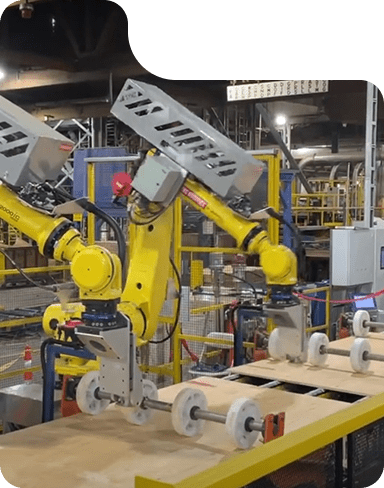
Robots are not the answer to every line problem, but they are extremely effective where repetitive handling causes placement errors, damage, or fatigue-related inconsistency. Pick-and-place applications, machine tending, palletizing, dispensing, and assembly are common examples.
A manual palletizing station is a good case study. Late in a shift, even strong operators start to lose precision. Cartons are placed slightly off pattern. Corners get crushed. Layer stability suffers. A robot, assuming the upstream product presentation is stable, will place every case to the programmed coordinates. That consistency reduces downstream transport damage and improves warehouse handling.
The same principle applies in delicate assembly. If a component must be inserted at a precise angle and force, a robotic cell with force sensing and guided motion can outperform manual assembly in both yield and repeatability. The benefit is not that people lack skill. It is that even highly skilled people vary over time, while machines repeat defined motion until a condition changes.
Still, robotics are not automatically error-proof. If part presentation is poor, tooling is wrong, or vision calibration drifts, the robot can make the same mistake very efficiently. That is why successful factory automation projects pay close attention to fixtures, infeed quality, verification, and maintenance access rather than focusing only on robot speed.
The biggest quality gains often come from better changeovers
Plants tend to chase errors during full-rate production because those losses are visible. In practice, some of the worst quality events happen at startup, shutdown, sanitation, maintenance restart, and product changeover.
During changeovers, operators make dozens of small decisions. Tooling is swapped, guides are moved, recipes are selected, line clearances are performed, labels are changed, and first-piece checks are completed. Every manual step introduces risk.
Automation helps by structuring this vulnerable period. Guided changeover sequences on the HMI, electronic verification of settings, servo-based auto-adjustments, digital checklists, and mandatory first-piece approvals all reduce missed steps. In one facility I visited, most labeling complaints were traced not to printer defects but to rushed SKU transitions on a line with frequent product swaps. Once scanner verification and recipe-linked label release were added, those complaints dropped sharply. The printer had never been the main problem. The process around it was.
This is one reason manufacturers with high product variety often see a strong return on manufacturing automation. The more often a line changes state, the more opportunities there are for setup error, and the more valuable automated controls become.
Data supports correction before defects multiply
When people hear about automation and analytics, they sometimes picture massive dashboards nobody uses. The useful reality is simpler. Good production data lets supervisors, engineers, and maintenance teams intervene early.
A line that records cycle time, reject rate, stop reasons, temperature bands, torque values, fill weights, and sensor health gives teams a practical view of process behavior. If reject rates climb gradually after lunch every day, that pattern is worth investigating. If one lane consistently underperforms, the issue may be mechanical alignment rather than operator technique. If a station requires repeated resets, the problem may be deeper than a nuisance fault.
A few metrics are especially helpful in reducing errors:
- First-pass yield, because it reveals how much product clears the line without rework
- Reject location, because it shows where defects are first detected
- Downtime by fault code, because recurring interruptions often correlate with quality drift
- Parameter trends, such as pressure, temperature, or torque, because they expose process instability
- Changeover-to-stable-run time, because it quantifies startup vulnerability
These metrics only matter if they are trusted. That means sensors must be maintained, fault categories must be meaningful, and data review must lead to action. Plants sometimes invest in advanced reporting but keep vague alarms like "station fault" or "machine error." Those do little to reduce mistakes. Specificity matters.
Maintenance quality is part of automation quality
No automation strategy reduces errors for long if the equipment itself is not maintained properly. Worn grippers, drifting sensors, loose couplings, contaminated optics, air leaks, and outdated recipes can all create a false sense of control. The line looks automated, but the process is no longer stable.
This is where experienced teams separate themselves. They do not assume the system is correct because it is programmed. They verify. They calibrate. They review alarm history. They replace components before failure. They treat maintenance as part of quality assurance, not just uptime management.
Predictive maintenance can help, but even disciplined preventive maintenance closes many gaps. A vision system lens cleaned on schedule may prevent hours of false rejects. A torque transducer checked routinely may catch drift before assemblies start failing in the field. An HMI recipe audit may uncover obsolete settings that survived a product update.
For companies exploring industrial automation Canada offers many examples in sectors like food, wood products, and metal fabrication where harsh environments challenge sensor reliability. Dust, washdown, vibration, and temperature swings all affect performance. The right automation design accounts for those conditions up front instead of forcing delicate components into unsuitable service.
Not every process should be fully automated
It is worth saying plainly that more automation is not always better. Poorly chosen automation can introduce new failure modes, create bottlenecks, and make simple tasks harder to recover from. The goal is not to automate for appearance. The goal is to reduce meaningful sources of error.
Some low-volume, high-variation operations still benefit from skilled manual work supported by selective automation, especially where product mix changes constantly or custom fitting is required. In those cases, the best answer may be semi-automated fixtures, guided work instructions, barcode validation, or in-line measurement rather than a fully robotic cell.
Judgment matters here. A good integrator or internal engineering team will ask where defects originate, what the cost of each error is, how stable the incoming process already is, and whether the workforce can support the new system. If the answer to every quality issue is https://elliotyhrf837.brightsora.com/posts/industrial-automation-canada-best-practices-for-smarter-plant-operations "add more equipment," the plant may end up automating symptoms instead of fixing root causes.
What a successful automation project usually gets right
The most effective error-reduction projects are rarely the most elaborate. They succeed because they are designed around actual process risk.
A few principles show up again and again. First, they define critical quality points clearly. If everything is critical, nothing is. Second, they build verification as close as possible to the point of error. Third, they make faults visible and understandable to operators. Fourth, they include production, maintenance, and quality teams early, because each group sees different failure modes. Fifth, they plan for the realities of plant life, dirty conditions, rushed restarts, worn parts, temporary staff, and urgent orders.
That is why industrial automation solutions pay off most when they are rooted in floor-level understanding rather than abstract technology goals. The strongest systems reflect how work is actually done, where people are forced to improvise, and which errors are most expensive to miss.
The real payoff is not just fewer defects
Reducing errors is the headline benefit, but it is not the only one. When automation makes a line more repeatable and transparent, several other improvements follow. Training gets easier because processes are standardized. Investigations move faster because data exists. Customer confidence grows because quality is more consistent. Teams spend less time firefighting and more time improving.
That shift changes the culture of a plant. Operators stop being the last barrier against preventable mistakes. Engineers spend less time guessing. Supervisors have cleaner information. Quality teams can focus on prevention instead of sorting and paperwork.
Seen from that angle, factory automation is not mainly about replacing manual effort. It is about designing error resistance into the process itself. The production line becomes less dependent on perfect attention, perfect communication, and perfect conditions, none of which exist for long in a real manufacturing environment.
That is the practical promise of manufacturing automation and well-built automation systems. They do not make a plant flawless. They make it harder for small mistakes to survive, spread, and become expensive. On a busy production line, that difference is often where profit, performance, and customer trust are won or lost.
Sync Robotics Inc. — Business Info (NAP)
Name: Sync Robotics Inc.Address: 2-683 Dease Rd, Kelowna, BC V1X 4A4
Phone: +1-250-753-7161
Website: https://www.syncrobotics.ca/
Email: [email protected]
Sales Email: [email protected]
Hours:
Monday: 8:00 AM – 4:30 PM
Tuesday: 8:00 AM – 4:30 PM
Wednesday: 8:00 AM – 4:30 PM
Thursday: 8:00 AM – 4:30 PM
Friday: 8:00 AM – 4:30 PM
Saturday: Closed
Sunday: Closed
Service Area: Kelowna, British Columbia and across Canada
Open-location code (Plus Code): VHWR+PQ Kelowna, British Columbia
Map/listing URL: https://maps.app.goo.gl/xwtV2wEu8ZuKH3se8
Embed iframe:
Socials (canonical https URLs):
LinkedIn: https://www.linkedin.com/company/syncrobotics/
Instagram: https://www.instagram.com/syncrobotics/
Facebook: https://www.facebook.com/syncrobotics/
https://www.syncrobotics.ca/
Sync Robotics Inc. is an industrial robot and controls integration company based in Kelowna, British Columbia.
The company designs and deploys automation solutions for manufacturing operations across Canada.
Services include industrial robotics integration, controls integration, automation system design, deployment support, and related manufacturing automation solutions.
Sync Robotics Inc. is located at 2-683 Dease Rd, Kelowna, BC V1X 4A4.
To contact Sync Robotics Inc., call +1-250-753-7161 or email [email protected].
For sales inquiries, email [email protected].
Hours listed are Monday to Friday 8:00 AM–4:30 PM, with Saturday and Sunday closed.
For directions and listing details, use the map listing: https://maps.app.goo.gl/xwtV2wEu8ZuKH3se8
Popular Questions About Sync Robotics Inc.
What does Sync Robotics Inc. do?Sync Robotics Inc. designs and deploys industrial robot and controls integration solutions for manufacturing operations.
Where is Sync Robotics Inc. located?
Sync Robotics Inc. is located at 2-683 Dease Rd, Kelowna, BC V1X 4A4.
Does Sync Robotics Inc. serve clients outside Kelowna?
Yes—Sync Robotics Inc. is based in Kelowna, British Columbia and serves clients across Canada.
What are Sync Robotics Inc.’s hours?
Monday–Friday: 8:00 AM–4:30 PM; Saturday and Sunday closed.
How can I contact Sync Robotics Inc.?
Phone: +1-250-753-7161
General Email: [email protected]
Sales Email: [email protected]
Website: https://www.syncrobotics.ca/
Map: https://maps.app.goo.gl/xwtV2wEu8ZuKH3se8
LinkedIn: https://www.linkedin.com/company/syncrobotics/
Instagram: https://www.instagram.com/syncrobotics/
Facebook: https://www.facebook.com/syncrobotics/
Landmarks Near Kelowna, BC
1) Kelowna International Airport2) UBC Okanagan
3) Rutland
4) Orchard Park Shopping Centre
5) Mission Creek Regional Park
6) Downtown Kelowna
7) Waterfront Park